Course Content
Session One: Course Overview
You will spend the first part of the day getting to know participants and discussing what will take place during the workshop. Students will also have an opportunity to identify their personal learning objectives.
0/1
Session Two: Defining Stress and How It Affects Us
To begin, participants will explore what stress is and the effects it can have. They will also work on identifying their stressors.
0/4
Session Three: What is Stress About?
This session will explore some of the things that stress is about. Participants will also learn about the positive effects of stress and what eustress is.
0/1
Session Four: Building a Solid Foundation
Next, participants will learn about the four pillars of stress management. Special focus will be given to relaxation techniques.
0/5
Session Five: Mental Strategies
This session will give participants two mental strategies to manage stress. They will also learn about the Triple A approach: alter, avoid, and accept.
0/2
Session Six: Stress at Work
During this session, participants will complete a stress inventory to help them identify areas of stress at work. Participants will also identify some solutions for work-related stress.
0/4
Session Seven: Time Management Tips
A little bit of planning can go a long way towards reducing stress. Participants will work in small groups to brainstorm ways of managing time.
0/2
Session Eight: Stress at Home
Next, participants will get some tips on running their household in a way that reduces stress, including budgeting, planning meals, general organization, and chores.
0/4
Session Nine: Drainers and Fillers
To wrap things up, participants will identify the things that drain and energize them.
0/2
Stress Management
About Lesson

If you find that you feel very stressed at work, and you’re not sure why, it can be useful to keep a stress log for a week to see what’s going on. Include the follow items:

  • Write the date at the top of each day.
  • Write the time and what happened.
  • Rate the event on a scale of one to ten, where one is a minimum of stress, five is, “I feel like I need a break,” and ten is, “I’m going to blow a gasket.”
  • Leave room for any comments or thoughts.

Here is an example.
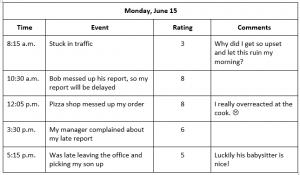
Once you have logged your stressful events, you can do something about them using the Triple A approach we discussed earlier. For example, if you got stuck in traffic four out of five days and that caused you stress, you may need to find a different route to work or leave at an earlier time to get ahead of the rush.

0% Complete