
Stressors lead to stimuli which evoke some kind of a response. Whether your response is physical or psychological, stressors require that we adapt and respond in some way. The greater the gap between the demands and the resources, the more stressful a situation becomes for us.
Some stressors are small, like finding there is no toilet paper when we go into the bathroom, or calling someone and their voicemail is full. Farther up on the scale, there are major negative events, like being caught in a storm and unable to get home through downed power lines, or being the victim of a crime. Looming larger are catastrophic events, often unexpected, such as natural disasters, acts of wars, or riots.
Events over which we have very little control, which occur suddenly and unpredictably, and which have an impact that lasts for a long period of time, generally have the biggest impact on physical and emotional health. In addition, even small events that are chronically repeated over a long period of time (like your colleague being late for work every day for a prolonged period) can be equally taxing.
Understanding Stress
These factors:
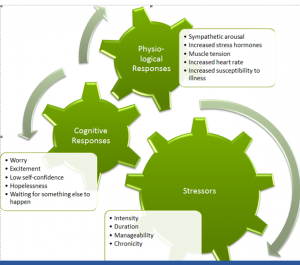
Can all contribute to these coping behaviors:
- Avoiding priority tasks
- Rigidity or disorganization
- Self-destructive behaviors (such as substance abuse or alcoholism)
(Sources: “Stress, Appraisal, and Coping” and “Psychology Frontiers and Applications”)
Stress and Your Health
Stress is a significant factor in health problems in the world today. Repeated stress, whether positive or negative, leads to a release of hormones in the body. It is the constant battering of these stress-related hormones that can have a negative effect on our health over time.
Dr. Peter Hanson, author of The Joy of Stress and many other books on managing stress, says that stress is neutral until it lands on us. What we choose to do about stress determines how it will affect us, and so while it does not directly “cause” these problems, it certainly contributes to them.
- Heart attacks or strokes
- Substance abuse (illegal drugs, improper use of prescription drugs, alcohol)
- Abdominal problems, such as irritable bowel syndrome
- Physical illness
- Hypertension
- Migraines
- High cholesterol
- Insomnia
- Depression and anxiety