
Earlier, we mentioned that a personalized plan should be sent to an employee before they start work. This template should be developed as part of the design process. It must be specific enough to gather necessary information, but flexible enough to be used for any new employee.
The template should include:
- Basic information such as the employee’s start date, their role, their department, and their supervisor
- Two-line job description
- List of stakeholders that they will meet
- Summary of pre-work
- Summary of Day One and Week One events and tasks
- Training plan
- Goals for the first 30, 60, and 90 days
This template should be completed by the employee and by their manager during the pre-work process. (Try not to give the employee specific directions when asking them to fill out the plan. This way, you can see their level of initiative and how detail-oriented they are.)
Then, before the first day of work, the manager should meet with the employee to finalize the plan. This gives the employee a solid understanding of what their role will entail, and assurance that they are on the same page as their manager (who is hopefully on the same page as the organization).
Day One
An employee’s first day is arguably the most important one. You only get one chance to make a first impression!
A typical first day should look like this:
- The employee arrives at the office on time and is greeted by the manager.
- Any security policies are completed. (Most companies will only issue an ID card on the start date, for example.)
- The manager introduces the employee to their mentor, their colleagues, and key stakeholders.
- The manager gives the employee a brief tour of the office, highlighting personal storage, lunch rooms, washrooms, and fire exits. (Tip: Mention what employees usually do for lunch. If possible, schedule a special welcome lunch with the employees’ colleagues.)
- The manager and the employee review the onboarding plan, focusing on tasks for the first day and week. They should also review key procedures, such as network access, e-mail, voice mail, safety procedures, emergency plans, etc.
- The employee takes part in a company and departmental orientation.
- The manager confirms that the employee has completed all necessary paperwork.
- The employee works on Day One tasks, supported by a mentor if needed.
- The manager checks in with the employee at the end of the day.
Week One
The goal of the first week should be to slowly start transitioning employees into normal work. The employee should also begin to build relationships with stakeholders and work on assignments. They may also take part in more training; either specific to their role or about company systems and procedures.
The manager should also share any unwritten rules (i.e. how casual are casual Fridays?) and traditions, and cover additional policies or procedures in depth as necessary.
Checking In
Gathering constant, comprehensive feedback about the onboarding process is very important, particularly during the employee’s first few days. If there are any issues, it is best to know about them as soon as possible so that they can be resolved quickly. Remember, this is a crucial evaluation period for the employee; they are checking you out and deciding whether or not they like what they see (just as much as you are checking them out!).
One of the most effective feedback tools is to ask the employees’ colleagues, “How is Joe doing?” during the week. If they have difficulty providing specific feedback, you can probe for more information using questions like:
- How do you feel that Joe is fitting in with the team?
- What do you think of Joe’s work habits so far?
- What do you think of Joe’s onboarding plan and tasks?
- Is there anything that I should know about Joe?
Be sure to check in with the employee themselves each day to see if they have any questions, comments, or concerns. It is also a nice gesture to schedule a one-on-one lunch midway through the week.
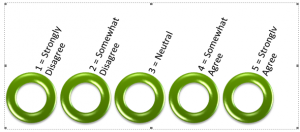
An informal onboarding review should take place at the end of the first week. Our favorite approach is a short list of questions with a simple five-point scale. The employee and their manager can complete this survey at the end of the week, compare results, and use it as a starting point for updating the onboarding plan and moving forward.
Sample Scale
Sample Questions
- I feel that the onboarding plan has been useful during my first week.
- I feel that I am fitting in well with my new team.
- So far, the position meets my expectations.
- The training that I have received so far has been useful.
- I had all the tools I needed on time.
- The tools that I received were useful.
- I have a good understanding of my department.
- I have a good understanding of my organization.
- I have reviewed all HR policies and signed all required documents.
Useful Open-Ended Questions
You can use these questions to gauge the employee’s overall experience and mood.
- What was your favorite thing about this week?
- What was your least favorite thing about this week?
- What would you change for future employees?
- How would you rate your first week on a scale of one (terrible) to ten (amazing)?
- Describe your week in one word.
Don’t forget to review the onboarding plan, particularly their day one tasks and week one goals.
Month One
During the first month, the employee will continue:
- Working through their onboarding plan, focusing on month one goals
- Working with their mentor, coach, or buddy (if applicable) to achieve goals and complete assignments
- Adapting to their new role
- Building relationships with colleagues and stakeholders
- Completing training (if applicable)
- Checking in with their manager at least once per week
- Bringing any issues to their manager that they need help resolving
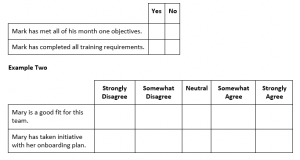
A formal onboarding review should take place at the end of the first month. There are many types of reviews, most of which resemble performance reviews (which it is, in a sense). Your first step is to prepare a short evaluation form. We recommend short, objective questions that can be answered yes or no, or subjective questions that can be answered using a simple scale. The form should be standardized across the organization, with room for customization in the questions (or the ability to add a few open-ended questions).
Example One
Invite the employee, their coach, and any other stakeholders to a half-hour meeting. Ask them to complete the evaluation form beforehand. During this week, check in with the employees’ colleagues and other stakeholders. Compile a list of positive feedback and constructive criticism.
Have the meeting in a quiet location that ensures privacy. Ask the employee for their evaluation first. Then, ask any other attendees to share their feedback. Finally, share your evaluation, including an anonymous summary of what co-workers and stakeholders thought.
Your goal during this meeting is to:
- Ensure that the employee is happy with their position so far – and if they are not happy, to determine what needs to change
- Assess any gaps in training and support and form a plan to address them
- Review goals for the first weeks and month and whether or not the employee met those goals
- Review the remainder of the onboarding plan, including goals, and adjust where appropriate
After the meeting, place all evaluations in the employee’s file and send the employee and their coach (if applicable) a summary of actions decided on. Include the onboarding plan and any revisions.