
Introduction
Three components are vital to knowledge management: people, technology, and process. The people are the driving power behind the knowledge management mix. After all, what is technology without use and a process without participation?
A successful knowledge management program links people and helps to make their jobs easier while simultaneously benefitting the organization. Without the buy-in of the people, the best system will fall flat and become a tool that falls into disuse. An organization needs to find and implement ways that easily connect people and promote knowledge sharing. Additionally, an organization needs to find ways to recognize people for their idea sharing and promote the concept throughout the company.
Below, we have listed some knowledge management techniques that can be used to connect people.
Company Directory
Creating a company directory or “yellow pages” can help connect people. This can be achieved manually or with a computer program that allows users to upload data about themselves. Ideally, each user will have their own page that provides basic contact information, their areas of expertise, a work history, their interests, key internal and external contacts, and a picture. This approach has an added bonus: helping to identify people with common needs and abilities. This information can be very helpful when establishing communities of practice, which we will talk about shortly.
If you decide to set up a company directory, make sure you are familiar with your country’s privacy laws. In many countries, this type of information is sensitive and may only be used with the employee’s permission. Additionally, your company may want to think about drafting a legal policy on the terms of use of the directory.
As well, the directory needs to be maintained since phone numbers and contact information can change frequently. One way to do this is to link the directory with HR databases.
Establish a Best Practice Database
A best practice is a solution that has been tried in one place and might be effective in another. These are ideas worth replicating. Allowing people to share their best practices not only connects people; it can also save the organization time and money.
Communities of Practice
Communities of practice are learning communities formed when people voluntarily come together to share information about a common topic or profession. Communities can be formed based on common interests, to solve a problem, or to reach a goal. The function of these communities is to connect people in the effort to build and share knowledge. These forums offer members the chance to grow both personally and professionally as they are able to learn from the experiences of others.
The members of these communities do not necessarily have to meet face to face for the community to exist. They can exist online as a discussion board or a website. However, most communities of practice have members meet face to face at least once a year. This gives the community a more personal, physical feel and gives members the opportunity to connect on a different level.
The most important member within a community of practice is the Community Coordinator. Their job is to help the community develop its practice and to help the community develop. The coordinator identifies gaps in the community’s knowledge, suggests ways to keep the community’s knowledge current on new issues, and acquires tools and resources the community may need to function.
To develop the community, the coordinator performs a variety of tasks. They develop an onboarding process for new members, which will teach newcomers the basics of the community. They also schedule community events that enable community members to congregate. Coordinators also monitor the activity level of a community, paying attention to lulls and rekindling interest. Coordinators can also act as online moderators, ensuring that questions get answered and watching for any inappropriate posts.
The most important role for the coordinator in building the community is to encourage networking. Thus, when thinking of who to appoint to this role, a community should consider the personal network of all candidates: the bigger their network, the better. The coordinator should also have great networking skills. The coordinator’s ability to connect people is vital since most of the knowledge sharing within a community happens on an individual basis. The better the coordinator’s networking skills, the more information will be shared.
An important point to note is communities of practice are different from an assigned team or group. The members of a community are there on a voluntary basis. Additionally, there are no set times for how long the community can last. Some may be in existence indefinitely while others may exist simply to solve a problem or reach a goal. The longevity of the community really depends on the members’ attitude toward the relevance of the community and whether or not the Community Coordinator is effective at their job.
Communities of practice are a vital component to a knowledge management system. However, they are meant to be voluntary. In order to build a community of practice within an organization, management should allow the community to develop as naturally as possible.
Tips for Developing a Community of Practice within an Organization
Here are some tips on how to develop a community of practice.
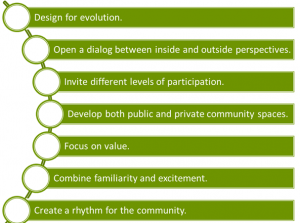
This model comes from the book Cultivating Communities of Practice: A Guide to Managing Knowledge, by Etienne Wenger, Richard McDermott, and William Snyder. Let’s look at each step.
Design for Evolution
It is important to view the community as a fluid environment. Members will come and go and the priorities of the group will change over time. For a community to succeed within an organization, management needs to be aware of the nature of the community and provide the resources that the community needs to grow.
Open a Dialog
The knowledge inside the community is paramount. However, members must be encouraged to look outside the community for new information or information that will help bridge gaps in community knowledge.
Invite Different Levels of Participation
Organizations must understand that different members will have different levels of participation. Some people will want to be heavily involved and lead in the community while others may want to learn through observing.
Develop Both Public and Private Community Spaces
Organizations need to support the fact that networking and knowledge transference occurs in a variety of ways. Thus, communities should have the ability to interact in both a public and private fashion. Examples of public interaction could be the community discussion board or a presentation open to all members of the community. Private community spaces would focus on one on one interaction, such as e-mail, phone calls, and informal conversations.
Focus on Value
A great way for an organization to jumpstart their communities of practice is to emphasize the value of membership. However, organizations need to be patient and understand that value is a matter of each member’s perspective. Value also takes time to build. Eventually, when knowledge is built and systematized, it is easy for members to see the value in belonging to the organization. To build value initially, the community needs to focus on the problems it is trying to address and on meeting the needs of its members. Through events like presentations, the community creates value by designing social spaces within which knowledge can be accessed.
Combine Familiarity and Excitement
Management should encourage their communities to combine familiarity and excitement for two purposes: to establish norms for processes and procedures and to encourage fresh thinking. Establishing norms in a community is important so that members know what to expect and have the ability to establish connections. Creating excitement is important to keep ideas fresh and to prevent stagnant thinking.
Create a Rhythm for the Community
Once a community is established, it is important for it to maintain a good rhythm. Too many events can leave members feeling fatigued; too few can leave members feeling lethargic. Establishing a good rhythm keeps the community relevant and current without fatiguing and exhausting members.
Summary
Communities of practice are a not-so-secret method for knowledge management. Any organization wishing to implement a knowledge management program must encourage these communities. They are vital for linking people within the organization and they are an organized space to promote how we naturally learn.