
Introduction
The KM Process Framework model was proposed by Wendi Bukowitz and Ruth Williams in 1999. It focuses on how organizations create, preserve, extinguish, and employ a body of knowledge to create value within the business.
Knowledge-based assets consist of:
- Knowledge repositories
- Relationships
- Information technologies
- Communication infrastructure
- Environmental responsiveness
- Organizational intelligence
- Failure
- External sources
Model Overview
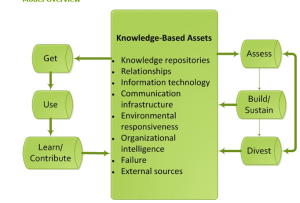
Breaking Down the Model
This model can be broken down into six stages that revolve around knowledge-based assets.
Let’s start on the left side of the model, beginning with get. This stage of the model involves the acquisition of knowledge in order to make decisions, solve problems, or innovate. The challenge with this stage is sifting through huge amounts of information in order to find what you are looking for.
Think about doing an Internet search on a particular topic. How many results do you normally get? How many results do you have to sort through to get the information you need? In the get stage, you need to sort through the information to find valuable knowledge in the effort to manage this knowledge for you own ends.
The next stage is the use phase. This stage looks at the information you have acquired in the effort to use this knowledge to your organization’s advantage. This stage encourages both individual and group creativity as a means to tailor knowledge for creative problem solving. In
this stage, you decide how to act on the knowledge acquired in the first stage and implement this knowledge in an appropriate solution.
The last component on the left-hand side of the model is the learn/contribute stage. This stage is the formal process of learning from experiences and acquired knowledge. In this stage, the knowledge is taken from group or individual processes and transferred into the collective knowledge of the organization. This is done through careful reflection and recapping of the solutions implemented in the “use” stage. The end goal is to expand the organization’s collective knowledge with the creation and contribution of best practices (knowledge success stories) and lessons learned (knowledge failure stories).
This learning phase is vital. Creating best practices and lessons learned helps to ensure that the experiences do not get lost within the organization. For example, let’s say that your organization attempts to implement a new policy and this implementation is extremely unsuccessful. Is it best to simply remove the policy and move on, or is it best to figure out and document why the implementation was unsuccessful for future endeavors? The point of learning and sharing is to ensure that positive changes are made within our organization.
This learning and sharing must also be done in a public place. Your company’s knowledge experience must be visible and accessible to the entire organization. This helps to promote your organizational culture as being one of learning and it allows the successes of employees to be shared.
On the right-hand side of the model is the assess stage. This stage deals with examining the existing knowledge within the organization. This is the stage within which we take an inventory of the knowledge and intangible assets we already possess. We need to assess the competencies of our people, the relationships we have with clients, our existing processes and procedures, our company culture, the relationships we have with other businesses, etc.
Once we have assessed the knowledge within our organization, we need to address the issue of value. Is this knowledge contributing to the organization or has it been warehoused? Does this knowledge give us a competitive edge or is it outdated? Assessing knowledge for value leads into the last stages of the model: build/sustain or divest.
If we view select knowledge within our organization as being valuable, we need to figure out a means through which we can build on this knowledge and sustain this knowledge. We need to allocate resources to grow and maintain our knowledge. These resources should promote the creation of new knowledge and reinforce existing knowledge.
If we view select knowledge within our organization as being unimportant, we need to divest this knowledge. We need to make sure that our resources are being spent on things that hold value and have the ability to create value for our organization. Spending money, time, and human resources on assets (physical or intellectual) which have no value will result in lost opportunities. You need to assess new and existing forms of knowledge to make sure it still has relevance and strategically cut out knowledge that is unimportant.
This divesting component is what sets Bukowitz and Williams’ model apart from most knowledge management models, since most models focus on sharing, creating, and organizing knowledge. Most models do not mention that it is important to rid our organization of unwanted clutter, including unimportant knowledge.