Course Content
Session One: Course Overview
You will spend the first part getting to know participants and discussing what will take place during the workshop. Students will also have an opportunity to identify their personal learning objectives.
0/2
Session Two: Definitions
Then, participants will learn the definition of knowledge, as well as the differences between tacit and explicit knowledge. The meaning and history of knowledge management will also be covered.
0/4
Session Three: The Business Case for Knowledge Management
In this session, participants will learn how knowledge management can reduce costs and grow sales. They will also learn how to build a business case for knowledge management. You will also examine the impact that knowledge management can have on business strategy and profit.
0/5
Session Four: The Knowledge Management Mix
Next, participants will learn about three components vital to knowledge management: people, technology, and process. In this session, you will examine the relationship between these three essential knowledge management components.
0/5
Session Five: The Knowledge Management Framework
The knowledge management framework is comprised of four interdependent elements: needs analysis, resource identification, process analysis, and knowledge handling. In this session, participants will learn about the steps to building their knowledge management framework: needs analysis; resource identification; process analysis, identification, and construction; and accumulating, sharing, and storing knowledge. In this session, you will investigate what the four elements of the knowledge management framework are and how they work together.
0/6
Session Six: ITandD’s Conundrum
A pre-assignment is designed to get you thinking about the topic, and to give you some indication of what is coming. In this example, the case study and the carefully crafted questions were intended to have you reflect on the vital role of knowledge within an organization. In this session, you will reflect on the answers you provided in the pre-assignment.
0/2
Session Seven: Knowledge Management Models
Knowing the theory behind the practice can increase your knowledge and inform what you do. Having a foundational awareness helps you to understand the theory’s evolution and history in the business world and better enable you to see how this system will fit into your organization. In this session, you will investigate four different knowledge management models.
0/6
Session Eight: The Knowledge Management Toolkit
Cross-functional Teams, mentoring, organizational culture, and IT solutions are all techniques that you can use employ when implementing a knowledge management program in your organization. In this session, you will explore each of these techniques in depth. As you review the information, think about ways that you could use each technique in your workplace.
0/9
Session Nine: Implementing Knowledge Management Initiatives
You see an organizational need for knowledge management. You understand what a knowledge management system is. You have the tools and information you need. Now it’s time to take action: it’s time to begin building the program. In this session, you will identify and investigate the necessary components for implementing a knowledge management program.
0/17
Recommended Reading List
If you are looking for further information on this topic, we have included a recommended reading list below. Bergeron, Bryan. Essentials of Knowledge Management. John Wiley & Sons, 2003. Dixon, Nancy M. Common Knowledge: How Companies Thrive by Sharing What They Know. Harvard Business School Press, 2000. O'Dell, Carla, and Cindy Huebert. The New Edge in Knowledge: How Knowledge Management Is Changing the Way We Do Business. New John Wiley & Sons, 2011. Pasher, Edna, and Tuvya Ronen. The Complete Guide to Knowledge Management: A Strategic Plan to Leverage Your Company's Intellectual Capital. John Wiley & Sons, 2011. Rumizen, Dr. Melissie Clemmons. The Complete Idiot's Guide to Knowledge Management. Alpha Books, 2002.
Knowledge Management
About Lesson

Introduction

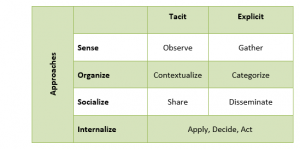
The knowledge management matrix is a theoretical model of the knowledge management process. Developed by Paul Gamble and John Blackwell in 2001, it focuses on the sharing of knowledge within an organization.

Model Overview
Breaking Down the Model

This model can be broken down into four stages:

  • Sense: In this stage, managerial level individuals or teams observe and gather sources of their organizational knowledge.
  • Organize: This gathered knowledge then needs to be allocated based on organizational gaps and assessed for value and importance.
  • Socialize: Once assessed for value and importance, the knowledge needs to be communicated to wherever and whoever needs it in the organization.
  • Internalize: Through use, the knowledge becomes internalized within the organization.

Case Study

Let’s use an example to illustrate this matrix. Your department is well known for its customer service, especially when dealing with challenging customers. Your company would like to examine how your department handles customer complaints to help other departments.

An individual or team would first observe and gather information about how employees in your department handle complaints. What do they do when dealing with customers?

Next, the knowledge management team would contextualize and organize the gathered information. They would assess how your department deals with complaints versus how the company deals with complaints. What is the difference? Which approach has more value? How can we bridge this organizational gap?

The knowledge of how your department deals with complaints would then be transferred to other departments. One strategy might be to have people in your department teach and observe people in other departments.

Over time and with the proper implementation and support, your department’s way of dealing with customers will permeate the company. This knowledge will become internalized within the organization through use.